“This book is a “must read” for people in the green building industry. It is well written, with good references and a clear message, certainly one of the most useful green building texts available. You hit the nail on the head!”
People may argue forever about which sustainability concerns should be incorporated in a green building rating system, but marketplace evidence argues decisively for keeping them to a small number.
As I describe in Chapter 15 of the book, what stands out for me are these key performance indicators, or sustainability KPIs:
1. Energy Use—With a “net zero energy” goal (setting aside the likelihood that very few buildings will or can ever become “plus-energy” buildings), this will include both direct combustion (natural gas or diesel for water heating, for example) and indirect combustion (electricity), while incentivizing onsite production from renewables or biomass boilers.
2. Water Use—Recognizing that we are entering a time of global water scarcities, brought on by population growth, climate change, increasing water footprints from agriculture, cities and industry, we need to reduce water use to an average achieved by lowest-using developed countries. (I do NOT support aiming for net zero water use in buildings, for reasons given in Chapter 12 of the book.)
3. Waste Diversion—Most US urban waste recycling systems seem to have peaked at around 35 percent waste diversion from landfill. It seems reasonable then to assess green buildings by starting with 50 percent diversion as a higher goal and embracing a zero waste ideal for waste generation and disposal.
4. Scope 3 Carbon Emissions—Scope 3 emissions are essentially “induced” emissions from corporate travel, freight deliveries and employee commuting. All can be easily tracked on a monthly basis from vendor invoices (which can be formatted for upload to FTP sites and then “grabbed” by dashboard APIs) and quarterly or semi-annually from employee surveys. Our goal is to encourage companies to reduce Scope 3 carbon emissions to zero through many means, including purchasing carbon offsets.
5. Ecological Purchasing—While it may be limited initially to office products and similar items bought from a handful of vendors, this measure would provide useful data. Some larger US office supply companies such as Staples and Office Depot have clear and valuable programs for labeling ecological products, which can then provide input to monthly invoices for determining the total percentage of purchases that meets these criteria. The goal is clearly to get 100 percent ecological purchasing for ongoing operations.
A rating system focusing on these KPIs might look like that shown below, based on these criteria, using absolute performance as the measure, instead of relative improvement. After all, why should the goals for green building be just "less bad" when you can be "absolutely good?"
Sustainability KPIs—A New Rating System
Points: Min-------------------------------Max
Energy 50 30% below 2012 CBECS Net Zero
Water 20 30% below US average 90% below
Waste 10 50% diversion 100% diversion
Scope 3 Emissions 10 50% below US average Net Zero
Purchasing 10 50% of purchases/year 100% of Total

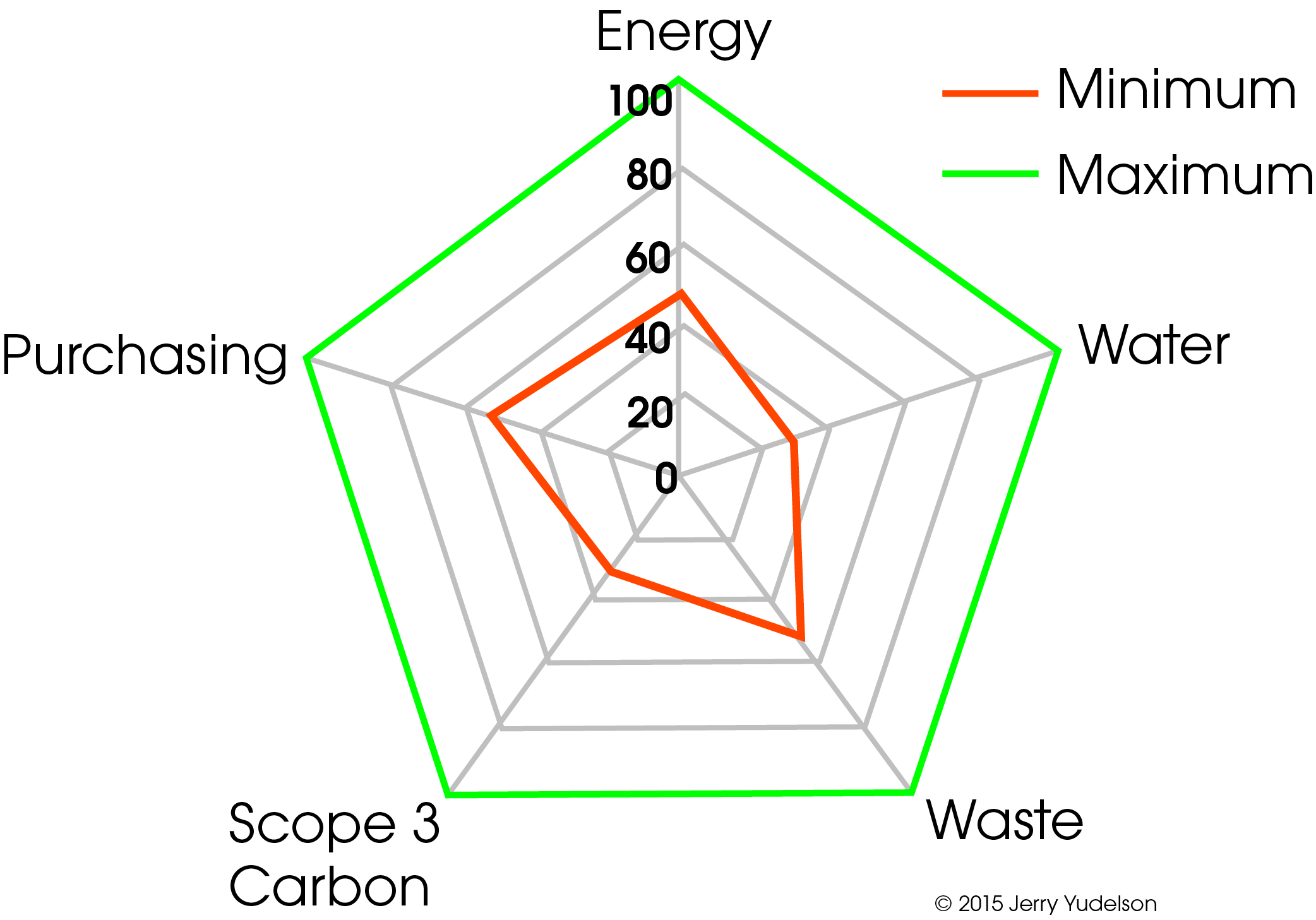
Schematic Rating System for Sustainability KPIs Might Look Like This
This approach is straightforward, works for just about every building type, is easy to explain to just about anyone and creates a compelling reason to get everyone on board for achieving sustainability goals! Don't you think that creating a radical simplicity in green building rating systems would really grow the market both for certification and for green building in general?